 Concept buildOpen site ↗
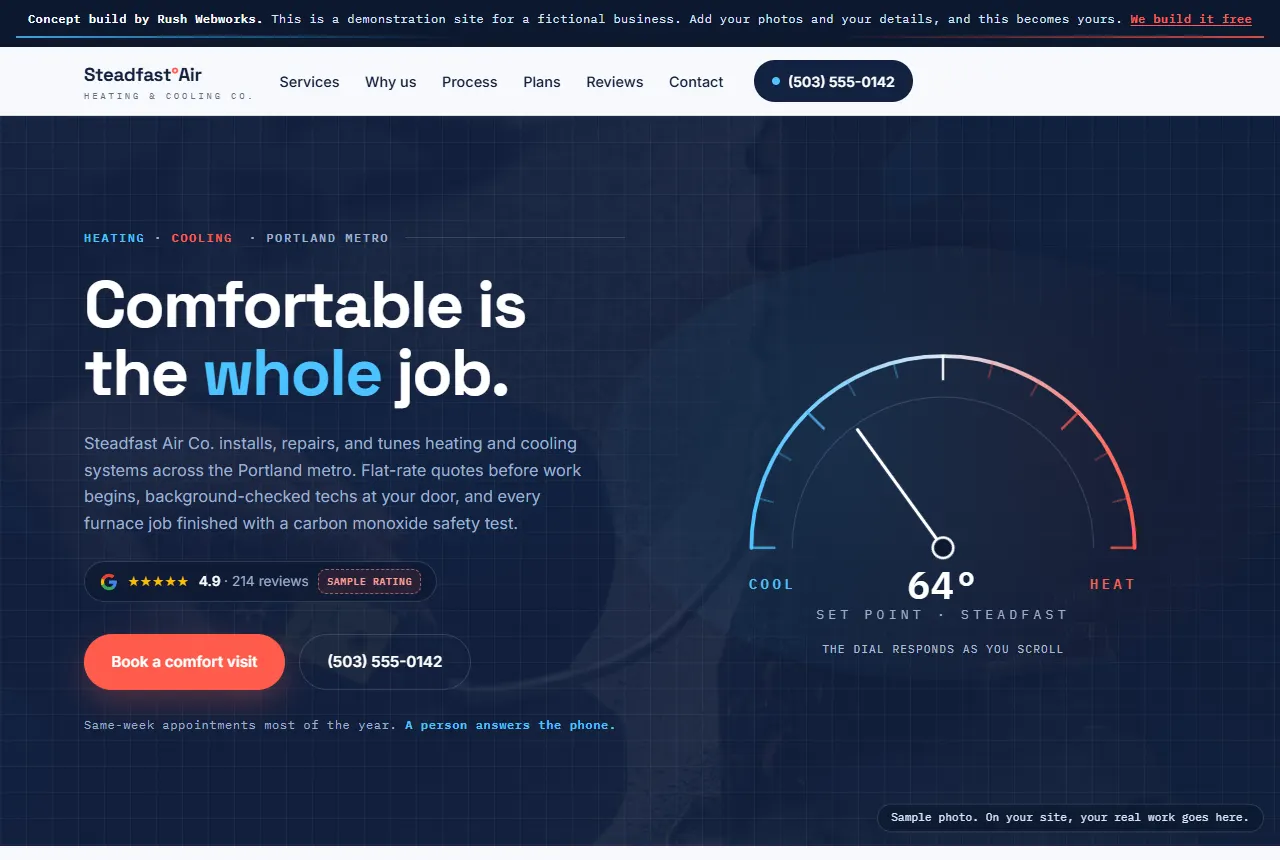
Steadfast Air Co.
Heating & cooling · concept
A scroll-reactive temperature dial, financing, and maintenance plans. HVAC with actual personality.
Websites for HVAC companies · Heating, cooling, heat pumps
Within two days, and before you pay anything, we put a first draft of your homepage on a private link: heating and cooling on their own pages, a dated rebate section that tells the truth about 2026, your CCB and electrical license numbers, and a request form that asks what heats the house now. Approve it and it launches for $99 a month, contract-free.
Rather talk? Call or text 503-908-3508, or book a 15-minute call. Leave a message and we call you back.
Your free site
Five quick fields. Nothing to pay, nothing to sign.
Google reviews
★★★★★
“Custom web design, easy to work with. Very responsive.”
★★★★★
“The speed and communication were incredible.”
★★★★★
“Thank you ! The best service and very professional got the page the way I wanted.”
★★★★★
“Mello truly went above and beyond the standard.”
★★★★★
“They took my rough ideas and pictures, and built a clean, intuitive site, that just works!”
★★★★★
“The site looks professional, functions exactly how I needed it to, and has been a huge asset for my business.”
The no-heat call wants a number that answers. The heat pump shopper wants to know what it costs, what still pays toward it in 2026, and whether you are licensed for the wiring as well as the ductwork. Your site has to handle both without making either one wait.
If your schedule fills from the service sticker on the furnace
A homeowner with a dead furnace on a cold night searches for repair, and the only trace of you is that sticker in the basement.
Heat pump shoppers ask about the federal tax credit on every estimate call, and you explain again that it ended with 2025.
Bigger shops show up online with financing pages and maintenance plans, and you show up as a phone number.
If your site is older than the rebate rules
The rebate page still promises a tax credit that no 2026 install can claim.
It never says which electrical license you hold, so a careful homeowner can’t tell who will do the electrical side.
Cooling and heating share one paragraph, so the search during a June heat wave lands on a competitor’s air conditioning page.
Either way, the first step is the same.
The draft homepage takes two days: we build it from your Google Business Profile, your license records, and the systems you install most, and post it on a private link. The draft is free to look over, and billing waits for your go-ahead. If a site is already up, it keeps working until the switch, domain and all. Running a heat pump promotion or a fall tune-up special? We build a landing page for it with the request form and the dated rebate facts on the same screen.
Why it matters
84%
of consumers say a business with a website is more credible than one with only a social media page.
Verisign, US consumer survey
97%
of consumers read online reviews for local businesses before they decide.
BrightLocal, Local Consumer Review Survey
75%
of people judge a company’s credibility by the design of its website.
Stanford Web Credibility Research
What the site does
A short incentives section that says what applies in 2026 and what doesn’t, with the date it was last checked. It sorts homes by how they heat now, because Energy Trust’s owner-occupied heat pump incentives depend on replacing electric heat.
A tap-to-call button on every page with your after-hours line beside it. In HomeServe’s 2026 survey, 22 percent of homeowners counted a heating or air conditioning repair or replacement among their emergencies of the past year.
Your CCB number and the BCD electrical license you hold, spelled out as LMS, LHR, CRE, or electrical contractor, plus your Washington registration and electrical license if you work there, each linked to its lookup.
A page that says you pull the Portland mechanical and electrical permits, or use the state’s minor label where it applies, and that the outdoor unit goes beside or behind the house, never in the required front setback.
A short estimate form that asks what heats the house now, whether there are ducts, and what the homeowner wants fixed: comfort, bills, or a dead system. The answers tell you which incentives might apply before you visit.
A plan page that lists what each visit covers and when it happens, so a one-time install has a reason to become a yearly visit.
A first draft of your homepage, on its own private link, within two days.
Other trades we build for: Electricians · Roofers · Painters · Deck builders · Fence companies · every trade
Heat, cooling, and the fine print
Oregon has no stand-alone HVAC license: the CCB license covers heating and air conditioning, and Portland’s mechanical permit asks only for the CCB number. Line-voltage electrical work takes a Building Codes Division license on top, such as the Limited Maintenance Specialty license, which covers replacing existing equipment but not installing it where none existed. Washington registers HVAC/R as an L&I specialty, and line-voltage work falls under its electrical law’s HVAC/refrigeration specialty, 06A or the restricted 06B.
Oregon CCB; ORS 479.620 and 479.630(12); WAC 296-200A-016(28); WAC 296-46B-920
Oregon’s CCB rule puts the CCB number on your website. No Building Codes Division rule asks for the electrical license number in ads, but its rules count advertising as engaging in the business, so advertising electrical work without the BCD license is itself a violation. Washington fines unlicensed electrical advertising $1,000 for a first offense, rising to $10,000, and a registered HVAC company’s L&I number goes on its ads.
OAR 812-003-0120; OAR 918-030-0010(8); RCW 19.28.041; WAC 296-46B-915; RCW 18.27.100
Portland requires a mechanical permit for heat pumps, furnaces, air conditioning condensers, and mini-splits, even when no building permit is needed, and most of those jobs need an electrical permit as well. The city issues permits within 24 hours of payment. An outdoor unit may not sit in the required front setback; in most residential zones it can go in a side or rear setback if it stands no more than five feet high.
Portland Permitting & Development, residential mechanical permits
In a November 2024 survey commissioned by Mitsubishi Electric Trane HVAC, 82 percent of heat pump owners said their contractor was somewhat or very influential in the decision to buy one. Oregon’s Department of Energy and Washington’s Labor & Industries both tell homeowners to get three quotes before choosing.
Mitsubishi Electric Trane Heat Pumps & Homeowners Index, Feb 2025; ODOE; Washington L&I F625-084-000
Fixr puts a heat pump installation at $5,000 to $15,000, averaging $8,350 (updated January 22, 2026). No federal or Oregon tax credit covers a 2026 install: the federal credit ended with improvements made through December 31, 2025, and Oregon’s energy tax credits ended in 2017. The state’s $2,000 heat pump incentive is fully reserved for existing owner-occupied homes, and Energy Trust of Oregon’s owner-occupied incentives, $1,000 ducted or $800 ductless, apply only when the heat pump replaces electric heat.
Fixr, read Nov 2026; IRS; ODOE funding table, Oct 1, 2026; Energy Trust incentive table, Nov 4, 2026
The Portland-Vancouver-Hillsboro metro employed 2,580 heating, air conditioning, and refrigeration mechanics and installers in May 2025, at a median of $31.38 an hour. Oregon’s license data counted 466 active LHR, 374 LMS, and 225 CRE electrical licenses statewide in October 2026.
BLS OEWS, May 2025, HVAC mechanics (49-9021); Oregon BCD license data, Oct 2026
Our work
Every card opens the real page. The live sites are client sites running today. The concept builds are demonstration sites for made-up businesses, and they say so.
How it works
1Two minutes
Your name, the business, what kind of work you do, and your email. A link to your current site or Google profile gets a closer first draft.
2Within two days
yourbusiness.rushwebworks.com. A first draft of your homepage, built around your business. Not a sketch, not a template. Nothing owed, nothing signed.
3When you say yes
Your photos and details go in, every page lands at your link for your approval, and we change whatever you want until it is right. Your first month is due the day it launches, with hosting, security, and updates included.
Two minutes. No payment info. No obligation.
The numbers, up front
What’s the catch? The monthly fee is the catch. We build free because the site has to keep earning its place in your budget. If it stops, you cancel and stop paying.
Portland agencies typically charge $3,000 to $15,000 to build, then $100 to $750 a month to keep it up. Here it’s $0 to build and one flat monthly. See where those numbers come from.
up to 3 pages
$0 to build
$39/mo
Heating, cooling, and rebate pages fit
up to 7 pages
$0 to build
$99/mo
10 pages, built for how you get work
$0 to build
$179/mo
An agency
$3,000 to $15,000 up front, then a retainer. Meetings. A ticket when something breaks.
Rush Webworks
$0 to build it. The Business plan runs $99 a month from launch day with hosting, security, and updates inside it, and when a rebate changes, the page changes as soon as you tell us. Cancel any month by email.
Free homepage first. Free full build. No contract. Cancel anytime.
Every number explained, including what happens if you cancel
No fine print
Straight answers
Both, labeled. The CCB number is the one Oregon’s advertising rule requires on a website. The LMS number isn’t required in ads, but advertising electrical work without the license that covers it counts as a violation on its own, so showing it settles the question before a homeowner asks. In Washington, your L&I registration number goes on ads under RCW 18.27.100, with your electrical contractor license beside it.
No promises, just the current facts with a checked date. For 2026 installs there is no federal or Oregon tax credit, and the state’s owner-occupied heat pump money is fully reserved, though as of October 1, 2026 its rental and new-construction pools still had funds. Energy Trust lists higher amounts for rentals and income-qualified households, $3,000 ducted and $1,800 ductless, under its own eligibility rules. Oregon’s federal home energy rebates have no open applications yet, and across the river, Clark Public Utilities pays $900 for a ductless heat pump in a home heated by an electric furnace or zonal heat. The page carries a last-checked date, and we update it whenever you send a change.
Yes, as ranges by system type. Fixr’s national figures, read in November 2026, run $2,000 to $8,000 for a ductless mini-split, $5,000 to $15,000 for a ducted air-source system, and $15,000 to $35,000 for geothermal. Post your own starting prices and say what moves them: the size of the house, the state of the ductwork, and whether the panel needs work for a new circuit.
A licensed contractor can often use the state’s minor label instead. BCD’s mechanical minor labels cover replacing existing heating and cooling equipment, adding central air to existing ductwork, and installing new mini-split heat pumps in one- and two-family homes, but not a replacement where the fuel type changes. Only contractors holding both BCD and CCB licenses can buy them, in lots of 10 for $140; each label must be reported within 30 days, and one installation in every 10 is picked at random for inspection. Anything outside that list goes through a Portland mechanical permit and its 699 final inspection.
Something short and dated. In May 2026 the EPA finalized a rule that removed the January 1, 2026 installation deadline for home air conditioners and heat pumps made or imported before 2025 with refrigerants above the rule’s 700 global warming potential limit, so that equipment can still be installed. Anyone who handles refrigerant still needs EPA Section 608 certification, which never expires, and the page can say your technicians hold it if they do.
Before the season turns, not after. Nationally, AHRI counted 440,819 air conditioners and heat pumps shipped in January 2026 and 1,023,571 in June, more than double, and Portland’s airport hit 116 degrees on June 28, 2021. Lead with furnace and heat pump service from fall through winter, switch to cooling by late spring, and keep both one tap away all year.
Your free site
Five quick fields. A first draft of your homepage lands on its own private link within two days. If you don’t love it, you owe nothing.
Rather talk? Call or text 503-908-3508, or book a 15-minute call. Leave a message and we call you back.
Free homepage first. Free full build. No contract. Cancel anytime.